


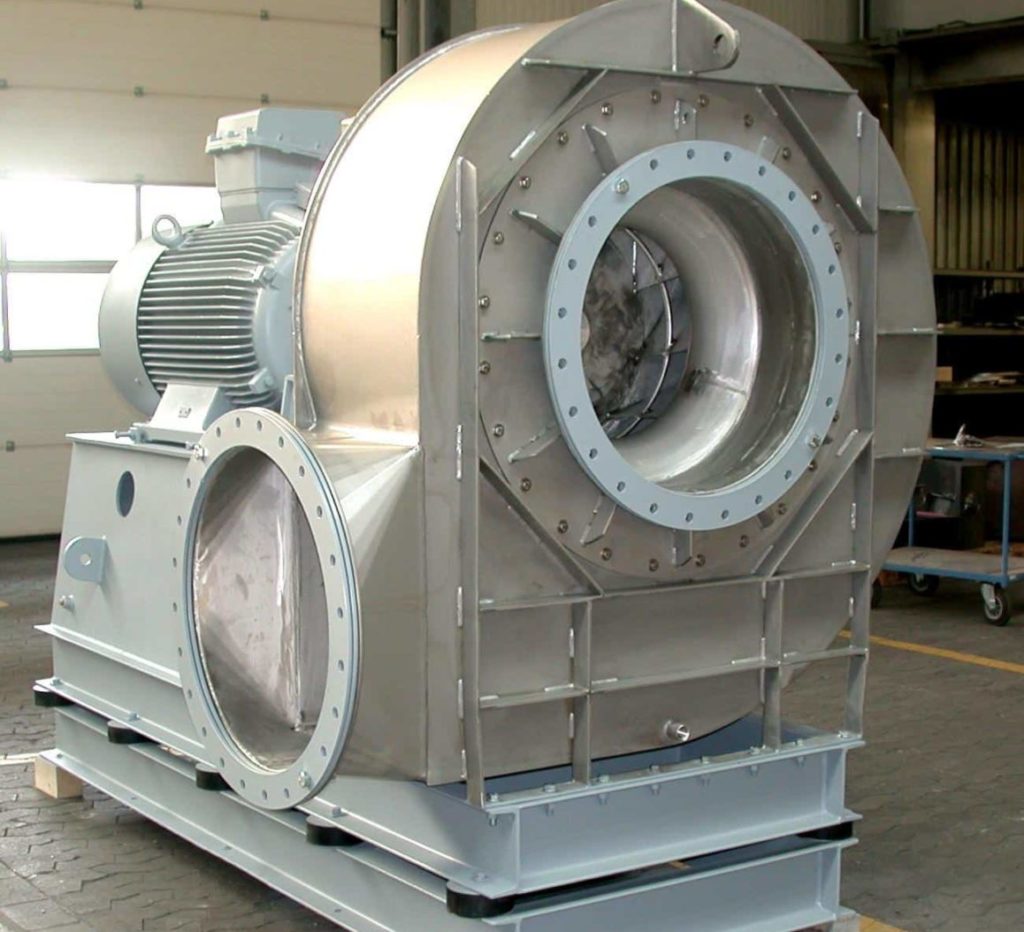
Corrosion-Resistant Fans for Exhaust Air and Corrosive Gases
A corrosion-resistant fan is essential wherever exhaust air contains acids, solvents or moisture.
A corrosion-resistant fan is essential for extracting exhaust air loaded with acid vapors, solvents, or aggressive gases. MECAVENT SA designs and supplies custom fans in stainless steel, plastic materials, or with anti-corrosion coatings for the chemical industry, surface treatment, laboratories, and wastewater treatment plants.

Transport of polluted air in deodorization and methanization units...
- Shaft seal, from simple Teflon seals to labyrinth seals with sealing gas injection.
- Continuously welded casing
Choosing the right material to combat corrosion
The service life of a fan exposed to exhaust air depends primarily on the choice of materials in contact with the gas. We determine this based on the composition of the extracted air, its concentration, temperature, and humidity:
- 304L or 316L stainless steel: for humid vapors, solvents, and high temperatures;
- Plastic materials (PP, PVC): for strong acids, bases, and chlorinated vapors at moderate temperatures;
- Anti-corrosion coatings: adapted to the chemical agent, to protect a steel fan.
A corrosion-resistant fan designed for aggressive gases
Beyond the material, the design matters: shaft seals, condensate drainage, fasteners, and contact parts in compatible materials. For connections, our flexible connectors in PTFE resist chemical and corrosive environments. ATEX versions available on request.
Applications
Surface treatment (galvanic baths, pickling, anodizing), chemical and pharmaceutical industry, laboratories and fume hoods, wastewater treatment plants and deodorization units, gas scrubbers, chemical storage.
Frequently Asked Questions
What information is needed to choose a corrosion-resistant fan?
The nature and concentration of the extracted gases or vapors, the air temperature and humidity, the required flow rate and pressure, and any zone classification (ATEX).
Stainless steel or plastic: which to choose?
Plastics are highly resistant to many acids and chlorinated vapors, but their temperature resistance is limited (generally between 60 and 90 °C depending on the material). Stainless steel withstands higher temperatures and is suitable for many solvents. We provide advice based on your specific application.
Can you replace a corroded fan?
Yes. We design replacement fans based on the performance and dimensions of the existing equipment, selecting a better-suited material if corrosion was rapid.
Why entrust your exhaust air extraction to MECAVENT?
With over 25 years of experience in industrial ventilation and acoustics, MECAVENT SA designs its custom fans and conducts tests in its workshops. We also provide regulation (drives, automation, sensors), flexible connectors, and acoustic treatment, and our technicians handle on-site installation and commissioning.
Corrosion-resistant fan: built for aggressive exhaust air
Exhaust air from chemical processes, laboratories, galvanising lines, scrubbers and water treatment often contains acids, alkalis, solvents or condensates. A standard steel fan corrodes quickly in these conditions, leading to imbalance, leaks and costly stoppages. A MECAVENT corrosion-resistant fan is designed from the start for the composition of the gas it will handle.
Depending on the chemicals, temperature and humidity, we build each corrosion-resistant fan in stainless steel, in carbon steel with protective coatings, or in plastics such as polypropylene and PVC. Shaft seals, drains and inspection doors are adapted to prevent leaks and allow condensate to be removed safely.
Sizing and noise
We size the corrosion-resistant fan for the real pressure losses of your scrubber, filter or stack, so that extraction remains effective without wasting energy. Silencers, acoustic enclosures and flexible connectors made of chemically resistant materials complete the installation and keep noise and vibration under control.
Emissions and safety
Reliable extraction of aggressive exhaust air protects operators and equipment and helps installations comply with emission limits, such as those under Directive 2010/75/EU on industrial emissions. ATEX versions are available for flammable vapours.